
On this page
The short versionWhat has changed since the last consultation?Why is this happening?My viewThe immediate timetableWhat Regulation 19 meansWhat happens after Regulation 19?What I will doQuestions & answersSources & article historyAn article from July 2026
This article was written before the August 2026 council decisions. It is preserved here as an explanation of the proposals and my position at that time. The timetable below is historical.
For the current position, see my Local Plan page, which I keep up to date.
Check the council’s current Local Plan information ↗The short version
The emerging Cotswold Local Plan now proposes a strategic development of around 1,020 homes south-west of Kemble, together with employment land, a local centre, a new primary school and substantial green infrastructure.
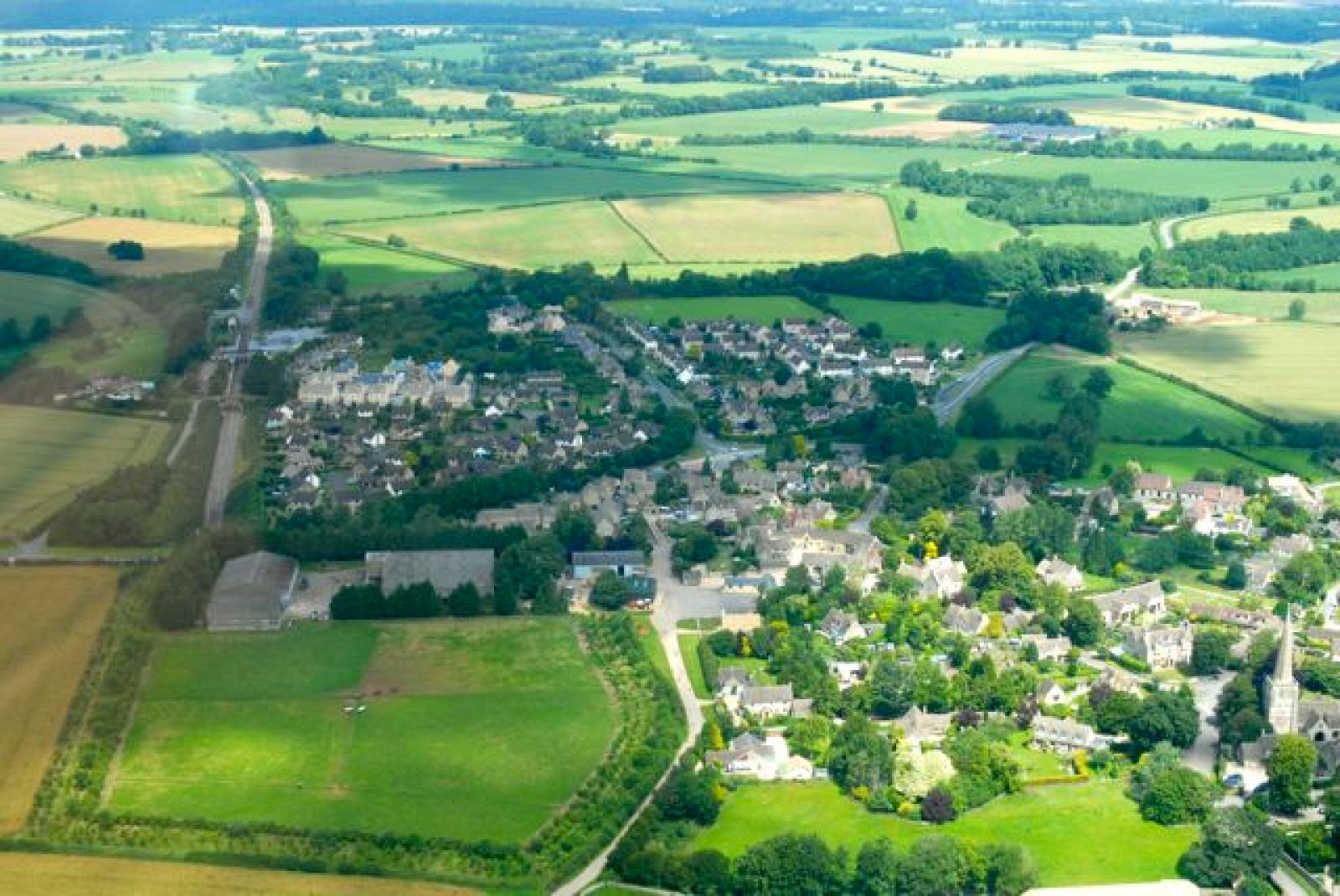
The proposal would fundamentally change Kemble, representing development on an exceptional scale relative to the existing village. I understand why many residents will feel shocked and anxious about it. I do too. The numbers are very large, and I do not believe the Government’s housing target for the Cotswolds reflects the realities of a rural district where much of the land is protected.
The proposal is not planning permission, and there are important decisions, consultation opportunities and safeguards still to come. But I also want to be candid: given the Government’s housing target, the site’s size and its rail connection, I judge development on this land to be very likely. The question is not whether we should pretend it might simply disappear. It is whether the Council can secure a coherent, properly planned development with the infrastructure Kemble needs, rather than leave the village exposed to less coordinated proposals.
My job as Kemble’s ward councillor is to be honest about the scale of what is proposed, to keep pressing for a more realistic national target, and to fight for the strongest possible protections, infrastructure and community benefit for Kemble.
What has changed since the last consultation?
At the previous Regulation 18 consultation, the draft plan referred to around 590 homes within the plan period and a wider, longer-term capacity of up to 1,070 homes.
The new Regulation 19 material proposes 1,020 homes by 2043. The overall potential scale of the land is therefore broadly similar to the larger number people saw previously. The major change is the delivery assumption: the Council now expects nearly all of the development to be capable of coming forward within this Local Plan period.
That higher delivery figure is based on the latest site work and on the landowner’s indication that different parts of the site could be brought forward by more than one developer at the same time. The current evidence anticipates first homes complete in around 2033/34 and a potential build-out rate of up to 150 homes a year. Those are planning assumptions, not a guarantee that development will happen exactly that way.
The concept framework currently shows:
- about 1,020 homes across an 83.6-hectare site;
- around 9 hectares of employment land;
- land for a two-form-entry primary school;
- a local centre;
- strategic open space, green infrastructure and sustainable drainage; and
- separate access points from the A429, with walking and cycling connections.
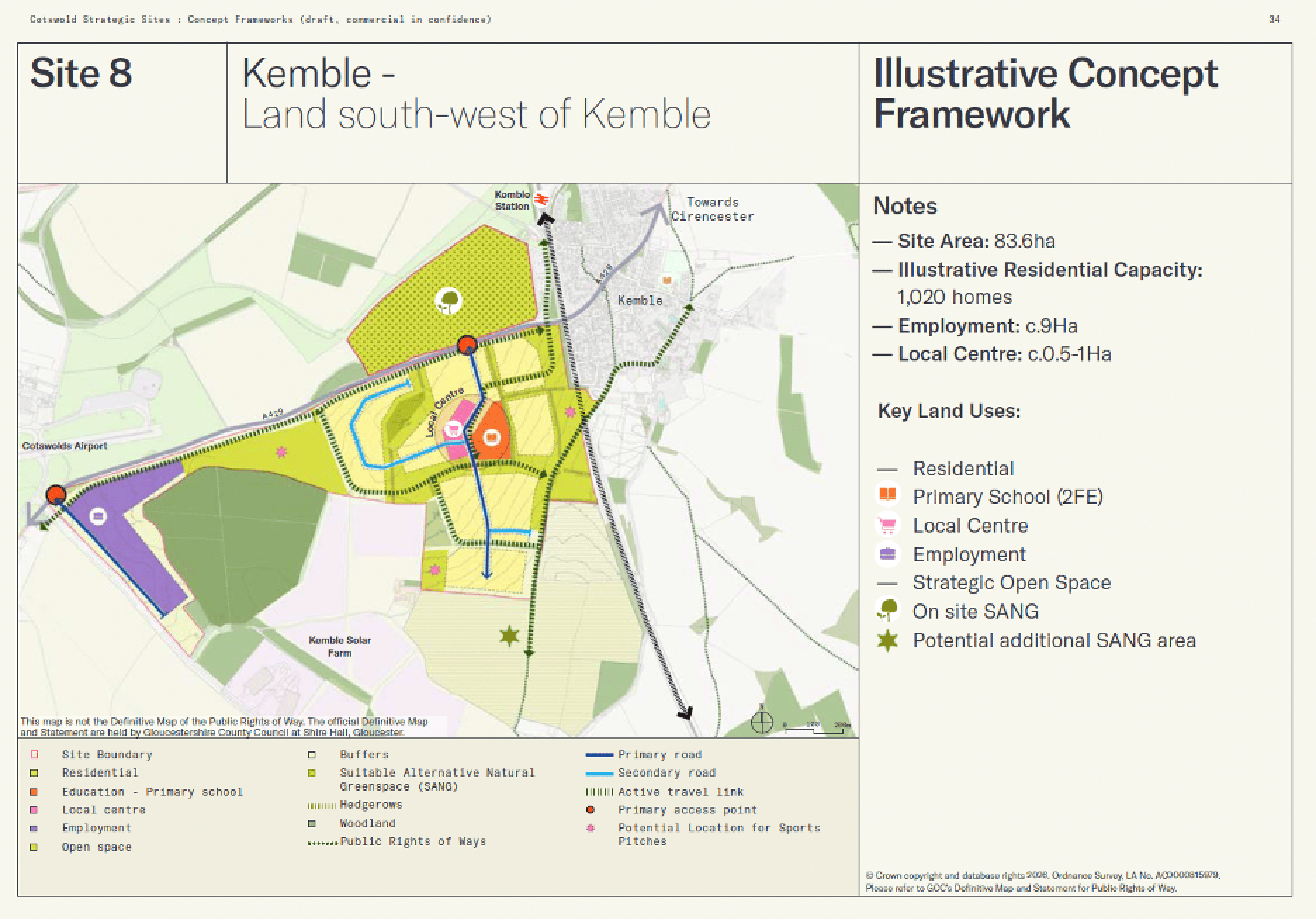
There is one important positive feature of the location. The site is on the far side of the railway line, beyond Top Farm and opposite Cotswold Airport. That creates a degree of physical separation from the existing village and gives an opportunity to plan a distinct new neighbourhood, rather than simply extending one existing street after another. It still adjoins Kemble, however, so that separation does not remove the impact on the village or the need for strong connections and safeguards.
Much remains to be designed, tested and secured. In particular, residents are entitled to clear answers on the timing and funding of the school, safe access to the station and village, traffic and road safety, health provision, water and wastewater capacity, landscape impact, flood risk, biodiversity, and the long-term management of green spaces.
Why is this happening?
The Government has imposed a very high housing requirement on Cotswold District Council. The Council has challenged the target with Government repeatedly, asking for a more realistic figure that properly reflects the Cotswolds’ rural character and extensive protected landscape. Those requests have not succeeded.
The consequence is that the Council has to demonstrate that it has looked seriously at all viable land capable of helping to meet the requirement. It cannot simply choose the locations it would most prefer. Sites enter the process because landowners and developers put them forward through the Call for Sites. The Council then assesses them against planning evidence: access, landscape, heritage, flood risk, ecology, infrastructure and deliverability, among other matters.
That does not make every offered site acceptable. But where there are not enough alternatives and a site cannot be ruled out on strong planning grounds, excluding it without robust evidence risks the Local Plan failing examination.
It is important to be honest about what that could mean in Kemble. A failed Local Plan would not make this land or the housing target disappear. The landowner and developers would be likely to pursue planning applications anyway, potentially through separate parcels or phases. With no up-to-date Local Plan and no five-year housing land supply, the national planning balance would be less favourable to the Council. We would have less ability to plan the development as one place, link housing to a coordinated infrastructure package, and require the school, roads, station connections, drainage, green space and other facilities to be delivered at the right time.
That is not an argument for accepting a poor allocation. It is an argument for using the Local Plan process to make the strongest possible case for a smaller impact where evidence supports it, and for clear, enforceable requirements where development is likely to proceed.
Kemble’s rail station is one reason the site has been considered strategically important. It also makes the test much tougher: if a development of this size is justified partly by access to rail, it must provide safe, direct and convenient walking, wheeling, cycling and public-transport connections from the outset. The station cannot be used as a reason for growth while access, capacity and parking pressures are left unresolved.
My view
I support building more genuinely affordable homes. Like many families, mine knows how difficult it is for younger people to find a secure and affordable home locally. But accepting the need for homes is not the same as accepting any scale of development, in any form, with infrastructure promised later.
The proposed scale for Kemble is too large to treat as routine development. It would fundamentally change the village. The Local Plan must require infrastructure first, not as an aspiration after houses have been occupied.
I will therefore continue to press for:
- a clear, public phasing plan showing how many homes are expected each year and what must be delivered before each phase;
- a funded education plan, including clarity about the proposed new primary school and the future of the existing school;
- safe, direct routes to the station, village centre, schools and Kemble Wick, backed by proper transport measures rather than more car dependency;
- binding requirements for roads, drainage, water, wastewater, electricity and healthcare capacity;
- firm protection for the setting of Kemble, Ewen and the conservation areas, the Special Landscape Area, ancient woodland and wildlife;
- genuinely net-zero homes, high-quality design, renewable energy and long-term stewardship of open space; and
- real engagement with residents and the Parish Council before the detail is fixed.
Note: Some of this is part of a planning permission, rather than the local plan
The immediate timetable
Before the Regulation 19 consultation opens, the draft Local Plan is due to be considered through the following Council meetings:
| Date | Meeting | Purpose |
|---|---|---|
| Monday 3 August 2026 | Overview and Scrutiny Committee | Scrutiny of the draft Local Plan before the formal decisions. |
| Thursday 6 August 2026, 6pm | Extraordinary Cabinet | Cabinet consideration of the draft Plan. |
| Wednesday 12 August 2026, 6pm | Extraordinary Full Council | Council decision on whether to publish the Plan for Regulation 19 consultation. |
Subject to those decisions, the Regulation 19 consultation is expected to begin in the week commencing 24 August 2026 for six weeks. The Council will publish the consultation documents, the formal dates and the way to comment.
I am also working with Kemble & Ewen Parish Council to arrange a village meeting once the Regulation 19 material is published. This will be an opportunity to examine the documents together, hear residents’ concerns and identify the issues that need a strong, evidence-based response. Details will be announced as soon as they are confirmed.
What Regulation 19 means
Regulation 19 is the final formal consultation on the version of the Local Plan that the Council intends to submit for examination. It is different from the earlier options consultation.
At this stage, comments should focus on whether the Plan is legally compliant and “sound”. In plain English, that means asking whether it has been properly prepared, is justified by evidence, can actually be delivered, and is consistent with national policy.
For Kemble, useful representations will need to be specific. They might address whether the proposed 1,020 homes are genuinely deliverable, whether infrastructure is costed and timed, whether the transport evidence is adequate, whether school and healthcare capacity are secured, or whether the landscape, heritage, flood-risk and ecological evidence is strong enough. General concern is understandable, but evidence-based points are more likely to carry weight at examination.
What happens after Regulation 19?
The broad process is:
1. Regulation 19 consultation. Residents, the Parish Council, statutory bodies and others submit formal representations on the proposed Plan.
2. Submission to the Planning Inspectorate. The Council sends the Plan, its evidence and the representations to an independent Planning Inspector appointed by Government.
3. Independent examination. The Inspector tests whether the Plan is sound and legally compliant. There may be public hearing sessions, where the Council, parish councils, residents’ representatives, landowners and developers can take part.
4. Inspector’s report and possible changes. The Inspector may recommend modifications. The Council cannot simply ignore those recommendations if it wants to adopt a sound Plan.
5. Adoption. If the process is successful, the Council can adopt the Plan. The current aim is adoption in 2027, but this depends on the examination process.
6. Planning applications. A Local Plan allocation is not a consent to build. Developers would still need to submit planning applications with detailed layouts, roads, drainage, landscape, ecological and transport assessments, infrastructure proposals and legal agreements. Each application would have its own public consultation and would be decided by the Council.
This means that there are two important opportunities to influence the outcome: first, through the Local Plan, which sets the principle, scale and required infrastructure; and later through the detailed planning applications, which decide the design, phasing and conditions on the ground.
What I will do
I will keep residents updated, work with Kemble & Ewen Parish Council, and make sure that concerns are put to the Council in a form that can be tested by the Inspector. I will continue to argue nationally for fairer housing targets for rural areas like ours.
My focus is to make sure Kemble is not asked to carry the consequences without the infrastructure, safeguards and local voice it deserves. No one should pretend that 1,020 homes is a small change, or that the site is likely to go away if the Local Plan does not allocate it. The task now is to be clear-eyed about it, make our case properly, and insist that any growth is genuinely planned around the needs of the existing and future community.
This article is written by Cllr Mike McKeown in his capacity as ward councillor for Kemble. It is not an official statement by Cotswold District Council.
Questions & answers
Answers to the questions covered in the original article, with conflicting planning terminology clarified.
Why are so many homes proposed for Kemble?
The site was put forward by a local landowner through the Call for Sites and assessed through the plan-making process. The original article linked its inclusion to the housing requirement, the district’s landscape constraints, limited alternatives and rail accessibility. These factors form part of a wider assessment; the council still has to justify its allocation with evidence.
Does this mean new houses are already approved?
No. A proposed allocation is not planning permission. If the plan is adopted, an allocation establishes policy support in principle, but developers would still need planning permission for a detailed proposal.
Why are we being told to plan for more homes?
The housing requirement comes from national policy. The council has to address that requirement through the Local Plan, even where it disagrees with the number.
Can the council refuse to include certain land?
The council can assess and reject sites, but its choices must be supported by planning evidence. The Inspector will test whether the plan is sound and legally compliant. Excluding a site without sufficient justification could create a risk at examination.
What happens if we do not have an up-to-date Local Plan?
Developers can still submit applications. An outdated plan and a shortfall in housing land supply can weaken the council’s position when applications and appeals are assessed. The outcome would depend on the evidence and policy in each case; the same development is not inevitable.
Does the review update policies as well as development areas?
Yes. It updates both planning policies, which guide decisions, and the locations proposed for new homes and jobs.
Is this about Kemble and Ewen parish or the whole ward?
The proposed site is within Kemble and Ewen parish and particularly affects Kemble village. Kemble ward covers a wider area.
What is a five-year housing land supply?
It is the supply of deliverable sites expected to provide housing over the next five years, measured against the relevant requirement. A shortfall can change the planning balance and make it harder to resist some applications. It does not automatically grant permission or remove all planning safeguards.
Do homes approved through speculative applications count?
Homes coming forward outside Local Plan allocations can contribute towards housing delivery. Their treatment in the supply calculation depends on the applicable evidence and methodology. Separate applications can make it harder to coordinate infrastructure across a wider area.
Why not build one new town or large village instead?
The original article explained that landowners had not offered a single suitable site large enough to meet the whole requirement. Available sites have to be assessed for suitability and deliverability, so the plan proposes development across several locations. This statement reflects the original article’s account of the options at that time.
Were public events planned for the consultation?
Yes. The original article described planned public drop-in sessions and exhibitions during the consultation. Its wording about forthcoming dates is historical. Use the council’s Local Plan page for current information.
How would infrastructure be delivered?
The Infrastructure Delivery Plan identifies needs such as schools, healthcare, transport, drainage and utilities. Detailed planning applications and legal agreements, including Section 106 obligations and the Community Infrastructure Levy where applicable, can help secure delivery or funding. Timing, viability, contributions and responsibilities still need to be established; inclusion in a plan is not a blanket guarantee.
What if there are not enough suitable sites?
The council needs to demonstrate how it has assessed land, explored reasonable alternatives and worked with neighbouring authorities. The original article suggested these steps might lead Government to reconsider the requirement. They do not create an automatic entitlement to a lower housing target.
Can residents influence the final plan?
Yes. At Regulation 19, representations address legal compliance and soundness. Specific evidence about a site, its effects or its deliverability can be tested at examination. Later planning applications also provide opportunities to comment on detailed proposals.
Sources & article history
Originally published on 25 July 2026. Migrated and edited for readability on 1 November 2026. The proposal figures, meeting dates and my stated position are retained from the original version.
The original FAQ included a conflicting statement suggesting that the site was already approved. This version clarifies that an allocation is not planning permission. Absolute claims about refusal, housing supply and a lower housing target have also been qualified. The original comparison with the village’s size and the precise count of Government challenges need further source checks, so they are described without those unverified figures.
- Cotswold District Council: Local Plan, documents and consultation information
- Council meeting papers and decisions
Written by Mike McKeown as ward councillor for Kemble. This is my explanation and view, not an official statement from Cotswold District Council.